

TestkingPDF NCP-CI-Azure Dumps PDF - 100% Passing Guarantee
NCP-CI-Azure Braindumps Real Exam Updated on Jun 08, 2026 with 83 Questions
Nutanix NCP-CI-Azure Exam Syllabus Topics:
| Topic | Details |
|---|---|
| Topic 1 |
|
| Topic 2 |
|
| Topic 3 |
|
| Topic 4 |
|
NEW QUESTION # 15
A company is extending asubnet from their on-premises environment to an NC2cluster on Azure. The company is considering using either a Virtual Tunnel End Point (VTEP) or a layer 2 subnet Extension over VPN.
In which two scenarios would it be advantageous to use VTEP for this requirement? (Choose two.)
- A. Only one remote Availability Zone exists that needs the subnet extended.
- B. Connectivity between sites already does not provided encryption.
- C. Multiple remote Availability Zones exist to add to the same VTEP-based extended Layer 2 subnet.
- D. Connectivity between sites already provides encryption.
Answer: C,D
Explanation:
* Scenario Analysis:
* A. Connectivity between sites already provides encryption: Using VTEP in this scenario is advantageous because VTEP does not inherently provide encryption. If encryption is already provided, VTEP can be effectively used without additional security concerns.
* D. Multiple remote Availability Zones exist to add to the same VTEP-based extended Layer 2 subnet: VTEP is well-suited for scenarios where multiple remote Availability Zones need to be connected to the same extended Layer 2 subnet. This allows for efficient management and seamless connectivity across different zones.
* Scenarios B and C:
* B. Only one remote Availability Zone exists that needs the subnet extended: This scenario does
* not leverage the strengths of VTEP, as it is better suited for multiple zones.
* C. Connectivity between sites already does not provide encryption: Using VTEP without existing encryption is not ideal as VTEP itself does not encrypt the traffic.
* Conclusion: VTEP is advantageous when encryption is already in place and when multiple remote zones need to be connected to the same extended subnet.
References:
* Nutanix NC2 Networking Guide
* Azure Networking Documentation
NEW QUESTION # 16
Exhibit.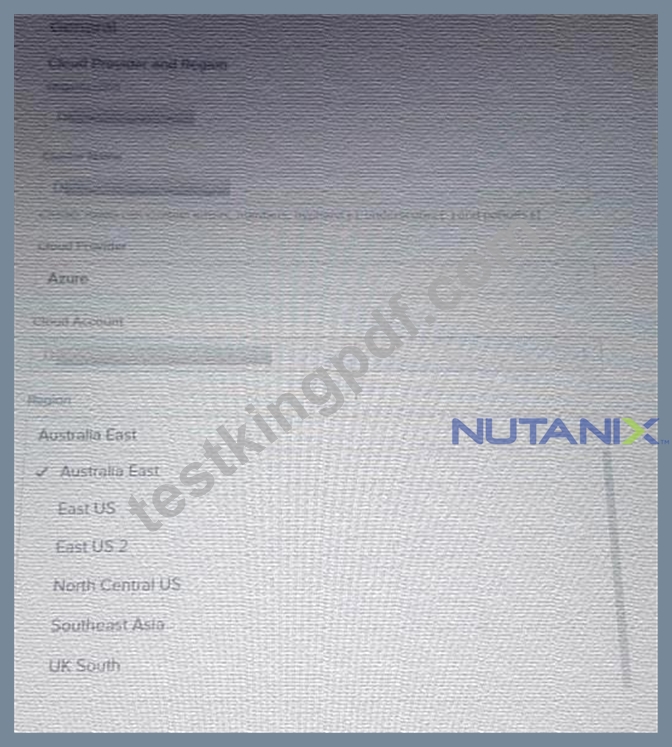
An administrator is trying to create an NC2 cluster in Azure, but does not see the required region in the drop-down list.
Which two steps could the administrator take to resolve this issue? (Choose two.)
- A. Check the NC2 Billingconsole to ensure the region is listed.
- B. Ensure that the Azure region is whitelisted for use by Microsoft in the subscription.
- C. Check the Azure subscription is created in the correct region.
- D. Check the list of regions specified under the NC2 organization cloud account.
Answer: B,D
Explanation:
* Check the list of regions specified under the NC2 organization cloud account:The list of available regions in the NC2 console might be restricted based on the configuration of the cloud account associated with the NC2 organization. Verifying this list ensures that the desired region is included and available for cluster creation.
* Ensure that the Azure region is whitelisted for use by Microsoft in the subscription:Sometimes, specific regions need to be explicitly enabled or whitelisted in the Azure subscription for certain services. This step ensures that the required region is permitted for use within the Azure subscription, allowing the NC2 cluster to be created in that region.
References:
* Azure Subscription and Service Limits Documentation
* Nutanix NC2 Configuration and Setup Guide
NEW QUESTION # 17
When configuring permissions for an Azure subscription, which role is required to delegate minimum permissions for the Azure AD App registration?
- A. Azure Reader role
- B. Azure Custom role defined by Nutanix
- C. Azure user Access Administrator role
- D. Azure Contributor role
Answer: C
Explanation:
Azure AD App Registration: When setting up an application registration in Azure AD, specific permissions are required to delegate access.
User Access Administrator Role: This role has the necessary permissions to manage user access to Azure resources, including delegating permissions for app registrations.
Comparison of Roles:
Azure Reader Role: Grants read-only access, insufficient for managing app registrations.
Azure Contributor Role: Allows creation and management of resources but does not include permissions to manage access.
Azure Custom Role: While it can be defined to meet specific needs, the User Access Administrator role is predefined to handle access delegation.
Conclusion: The Azure User Access Administrator role is required to delegate minimum permissions for Azure AD App registration.
Reference:
Azure Role-Based Access Control Documentation
Azure AD App Registration Guide
NEW QUESTION # 18
An administrator has noticed the company's NC2 free trial expired 60 days ago.
What should the administrator do to continue using all of the NC2 features on existing clusters?
- A. Contact Nutanix support to redeploy the cluster.
- B. Switch to a paid subscription plan.
- C. Nothing. The clusters will have full feature support.
- D. Contact the cloud vendor.
Answer: B
Explanation:
Free Trial Expiration: Once the NC2 free trial period expires, the administrator needs to switch to a paid subscription plan to continue using all the features and functionalities provided by Nutanix NC2.
Paid Subscription Benefits: Transitioning to a paid subscription ensures uninterrupted access to NC2 features, support, and updates, maintaining the operational capabilities of the existing clusters.
Reference:
Nutanix Subscription and Billing Documentation
Nutanix NC2 Support and Subscription Guide
NEW QUESTION # 19
An administrator needs to extend an on-premises subnet to an NC2 cluster on Azure.
Which set of options should the administrator configure to complete this task?
- A. Subnet Type: On-premises VLAN subnets and VPC subnets Traffic Type: IPv6 umcasi traffic and ARP On-premises Hypervisor: Hyper-V
- B. Subnet Type: On-premises VLAN subnets and VPC subnets Traffic Type: IPv4 unicast traffic IPv6 unicast traffic and ARP On-premises Hypervisor: ESXi and AHV
- C. Subnet Type: On-premises VLAN subnets and VPC subnets Traffic Type: IPv4 unicast traffic and ARP On-premises Hypervisor: AHV
- D. Subnet Type: VPC subnets
Traffic Type: IPv4 unicast traffic and ARP
On-premises Hypervisor: ESXi, AHV, Hyper-V
Answer: B
Explanation:
To extend an on-premises subnet to an NC2 cluster on Azure, the administrator should configure:
* Subnet Type:Both on-premises VLAN subnets and VPC subnets. This ensures that the subnet can span both the on-premises environment and the Azure environment.
* Traffic Type:Support for IPv4 unicast traffic, IPv6 unicast traffic, and ARP is necessary to ensure
* proper communication and address resolution across the extended subnet.
* On-premises Hypervisor:ESXi and AHV are supported hypervisors for this type of configuration, allowing for a seamless extension of the subnet between these environments.
References
* Nutanix Hybrid Cloud Networking
NEW QUESTION # 20
An administrator seeks to ensure that the newly-created NC2 organization named Finance can only deploy clusters into certain cloud regions.
Which action should the administrator take to do this?
- A. Configure RBAC roles on the Finance NC2 organization to allow access to regions.
- B. Specify allowed regions when configuring a cloud account for the Finance NC2 organization.
- C. Open a support ticket with Nutanix to whitelist the allowed regions for the Finance N
- D. Configure permissions in cloud accounts to restrict access to certain regions.
Answer: B
Explanation:
Cloud Account Configuration: When setting up a cloud account for the NC2 organization, the administrator can specify which regions are available for deploying clusters.
Restricting Regions: This ensures that the Finance organization can only deploy clusters into the designated regions, complying with organizational policies and requirements.
Reference:
Nutanix NC2 Configuration Guide
Azure Subscription and Resource Management Documentation
NEW QUESTION # 21
An administrator deploys an NC2 cluster in Azure and uses 10.100.0.0/16 for one of the VNets.
The cluster is configured as follows:
* 8 nodes
* Prism Central Deployed
* Files Deployed
Following the deployment, the administrator experiences network connectivity issues.
Which reason explains the connectivity issues?
- A. The 10.100.0.0/16 range is not a valid CIDR range.
- B. The 10.100.0.0/16 range is reserved by IANA.
- C. The W.100.0.0/16 range contains too many IP addresses for an NC2 cluster.
- D. 10.100.0.0/16 range is reserved for internal cluster usage.
Answer: D
Explanation:
* Network Configuration: Using a specific IP range for a VNet can cause conflicts if that range is reserved or already in use by the cluster's internal operations.
* Internal Usage: In NC2, certain IP ranges are reserved for internal cluster functions and should not be used for VNets to avoid IP conflicts and connectivity issues.
* Impact: If the 10.100.0.0/16 range is reserved for internal usage, using it for a VNet would lead to IP conflicts, causing network connectivity issues.
* Verification: It's important to verify the reserved IP ranges in the NC2 documentation before assigning them to VNets.
* Conclusion: The connectivity issues are likely due to using the 10.100.0.0/16 range, which is reserved for internal cluster usage.
References:
* Nutanix Networking Guidelines
* Azure Virtual Network Documentation
NEW QUESTION # 22
An administrator is planning an NC2 deployment in Azure and wants to connect the company's on-premises datacenter to the cloud environment.
What connectivity solution should the administrator use to avoid traffic between the locations flowing over the public internet?
- A. Site-to-Site VPN
- B. VTEP Gateways
- C. ExpressRoute
- D. Point-to-Site VPN
Answer: C
Explanation:
To connect the company's on-premises datacenter to the Azure cloud environment while avoiding traffic over the public internet, the administrator should use Azure ExpressRoute. ExpressRoute provides a private connection to Azure, offering more reliability, faster speeds, and lower latencies compared to typical internet connections. This service ensures that data traffic does not traverse the public internet, enhancing security and performance. Reference Azure ExpressRoute Overview
NEW QUESTION # 23
What is the minimum number of nodes needed to deploy an RF3 NC2 cluster?
- A. 0
- B. 1
- C. 2
- D. 3
Answer: A
Explanation:
Replication Factor (RF3): RF3 requires that data is replicated across three different nodes to ensure data durability and fault tolerance. This replication scheme allows the system to tolerate the failure of two nodes simultaneously.
Minimum Node Requirement for RF3: To meet the RF3 requirements while maintaining operational capability, a minimum of five nodes is necessary. This configuration ensures that there are enough nodes to distribute the data and provide the necessary redundancy.
Reference:
Nutanix Replication Factor Documentation
Nutanix NC2 on Azure Deployment Guide
NEW QUESTION # 24
An administrator is deploying a new cluster on Azure and would like to ensure the data is encrypted. Due to cost constraints the deployment will leverage the native local key manager (LKM).
What is the minimal number of nodes needed to support the Nutanix native LKM?
- A. 0
- B. 1
- C. 2
- D. 3
Answer: D
Explanation:
Local Key Manager (LKM): The native local key manager in Nutanix requires a minimum number of nodes to function correctly and provide key management services.
Minimum Node Requirement for LKM: To support the Nutanix native LKM, at least three nodes are needed. This configuration ensures that the key management service can achieve the necessary quorum and redundancy for secure operations.
Reference:
Nutanix Data Encryption Documentation
Nutanix Cluster Configuration Guide
NEW QUESTION # 25
Which interface must be used to deploy NC2?
- A. NC2 Tile within the my.nutanix.com portal
- B. Foundation running in a Cloud Virtual Machine
- C. Cloud Provider portal
- D. Prism Central Dashboard
Answer: A
Explanation:
my.nutanix.com Portal: This portal provides access to various Nutanix services and features, including the NC2 deployment interface.
NC2 Tile: The NC2 tile within the portal is specifically designed for deploying and managing Nutanix Cloud Clusters. It provides the necessary tools and settings to initiate and configure NC2 clusters on Azure or other cloud environments.
Reference:
Nutanix NC2 Deployment Guide
my.nutanix.com Portal Documentation
NEW QUESTION # 26
An administrator has noticed the company's NC2 free trial expired 60 days ago.
Whatshouldthe administrator do to continue using all of the NC2 features on existing clusters?
- A. Contact Nutanix support to redeploy the cluster.
- B. Switch to a paid subscription plan.
- C. Nothing. The clusters will have full feature support.
- D. Contact the cloud vendor.
Answer: B
Explanation:
* Free Trial Expiration:Once the NC2 free trial period expires, the administrator needs to switch to a paid subscription plan to continue using all the features and functionalities provided by Nutanix NC2.
* Paid Subscription Benefits:Transitioning to a paid subscription ensures uninterrupted access to NC2 features, support, and updates, maintaining the operational capabilities of the existing clusters.
References:
* Nutanix Subscription and Billing Documentation
* Nutanix NC2 Support and Subscription Guide
NEW QUESTION # 27
An organization want to use existing Azure resources to deploy NC2.
What is a valid requirement to use existing Azure resources for this task?
- A. More than two DNS servers must be used.
- B. A new Azure resource group must be created where all resources, such as VNets must be created.
- C. Azure NAT gateway must be attached to the cluster management Prism Central, and external Flow Gateway subnets.
- D. The fastpathenabled tag must be added after creating a NAT gateway.
Answer: B
Explanation:
* Resource Group Requirement:When deploying NC2 on Azure, it is essential to organize resources such as VNets, subnets, and other components in a dedicated resource group. This helps in managing and maintaining the resources efficiently.
* New Resource Group:Creating a new Azure resource group ensures that all the necessary NC2 resources are isolated and managed together, avoiding conflicts with existing resources and providing a clear separation for administration and billing purposes.
References:
* Azure Resource Group Documentation
* Nutanix NC2 Deployment Guide
NEW QUESTION # 28
An administrator is seeking help with an ongoing NC2 issue. After reaching out to Nutanix support, the administrator is introduce to the NC2 specialist who can help troubleshoot the problem.
How can the administrator verify that the NC2 specialist has access to the necessary organizations?
- A. Confirm the Support Authorization on the organization is set to Full Access.
- B. Provide the specialist with the administrator's login credentials.
- C. Add the specialist as an admin user to the organizations.
- D. Ensure the specialist is assigned the RBAC role with proper permissions.
Answer: A
Explanation:
To verify that the NC2 specialist has access to the necessary organizations for troubleshooting the issue, the administrator should:
* Confirm that theSupport Authorizationon the organization is set toFull Access. This ensures that the NC2 specialist has the required permissions to access the necessary resources and perform the necessary actions to resolve the issue.
Providing login credentials or adding the specialist as an admin user is not recommended due to security and privacy concerns. Ensuring the specialist is assigned the correct RBAC role is another valid approach but confirming the support authorization directly ensures they have the needed access.
References
* Nutanix Support and Services
NEW QUESTION # 29
An administrator seeks to ensure that the newly-created NC2 organization named Finance can only deploy clusters into certain cloud regions.
Which action should the administrator take to do this?
- A. Configure RBAC roles on the Finance NC2 organization to allow access to regions.
- B. Specify allowed regions when configuring a cloud account for the Finance NC2 organization.
- C. Open a support ticket with Nutanix to whitelist the allowed regions for the Finance N
- D. Configure permissions in cloud accounts to restrict access to certain regions.
Answer: B
Explanation:
* Cloud Account Configuration:When setting up a cloud account for the NC2 organization, the administrator can specify which regions are available for deploying clusters.
* Restricting Regions:This ensures that the Finance organization can only deploy clusters into the designated regions, complying with organizational policies and requirements.
References:
* Nutanix NC2 Configuration Guide
* Azure Subscription and Resource Management Documentation
NEW QUESTION # 30
An administrator has been tasked with deploying a new production NC2 cluster on Azure and is studying the deployment requirements.
How many Azure Ready Nodes, at a minimum, must the administrator ensure are deployed withinthe cluster?
- A. 0
- B. 1
- C. 2
- D. 3
Answer: D
Explanation:
* Minimum Node Requirement:For production deployments, Nutanix typically requires a minimum of three nodes to ensure high availability and fault tolerance within the cluster.
* Azure Ready Nodes:Deploying at least three Azure Ready Nodes allows the cluster to provide redundancy, ensuring that the failure of a single node does not affect the overall availability and performance of the cluster.
References:
* Nutanix NC2 on Azure Deployment Guide
* High Availability and Redundancy Best Practices
NEW QUESTION # 31
A nutanix User VPC named Servers has a subnet named Tier1:
Servers: 10.0.0.0/20
Tier1: 10.0.0.0/25
Tier is using floating IPS to allow inbound traffic to the web servers that are hosted for a payroll system.
The company requires that the Network Security Group allow other Native Azure instances running in subnet AD (10.20.0.0/24) in the Prism Central VNet to be able to contact the web servers.
Which statement is true regarding this company requirement?
- A. Native Azure instances \n the Prism Central vNet will be allowed access by default.
- B. Policy based routing in the Servers VPC must be edited to allow traffic from 10.20.0.0/24.
- C. The internal NIC of the Flow Gateway Network Security Group needs to allow to traffic from 1
10.20.0.0/24. - D. The external NIC of the Flow Gateway Network Security Group needs to allow traffic from
10.20.0,0/24.
Answer: C
Explanation:
* Flow Gateway Network Security Group (NSG):NSGs control the traffic flow to and from network interfaces associated with VMs and other resources. Configuring the NSG correctly is crucial for ensuring that required traffic is allowed.
* Internal NIC Configuration:To allow Native Azure instances in the Prism Central VNet (10.20.0.0/24) to access the web servers in the Tier1 subnet, the internal NIC of the Flow Gateway must be configured to allow traffic from 10.20.0.0/24. This ensures that inbound traffic from these instances is permitted and properly routed to the web servers.
References:
* Azure Network Security Group Documentation
* Nutanix Flow Gateway Configuration Guide
NEW QUESTION # 32
An administrator is deploying an NC2 cluster in Azure and observes on NC2 console that nodes will not progress and continue in a Booting state.
What is the most likely cause for the node not continuing to deploy?
- A. An Azure Support case must first be submitted for allowlisting the Azure subscription.
- B. A private DNS server is being used that is not reachable.
- C. The subscription has not been validated to be allowlisted by Microsoft.
- D. The Azure account does not have an active subscription.
Answer: C
Explanation:
* Azure Subscription Validation: When deploying an NC2 cluster, the Azure subscription must be validated and allowlisted by Microsoft. This is a crucial step to ensure that the necessary permissions and configurations are set up for the deployment.
* Booting State Issue: If the nodes are stuck in the Booting state, it often indicates that the subscription has not been properly validated and allowlisted. This prevents the deployment from progressing as required resources and permissions are not fully accessible.
* Checking Allowlisting Status: Administrators should verify that their subscription has been allowlisted by contacting Azure support or checking the status through the Azure portal.
* Resolution: Once the subscription is validated and allowlisted by Microsoft, the deployment should proceed without the nodes getting stuck in the Booting state.
References:
* Nutanix NC2 on Azure Documentation
* Azure Subscription Management
NEW QUESTION # 33
Which resource is capable of being connected to a private endpoint as it is not displayed on delegated subnets?
- A. CVMs
- B. Hosts
- C. Prism Central
- D. User VMs
Answer: C
Explanation:
Private Endpoint: Private Endpoints allow secure access to Azure services over a private network connection. They do not typically appear on delegated subnets, which are used for specific Azure services.
Prism Central Connectivity: Prism Central can be connected to a private endpoint to ensure secure communication without exposing it to the public internet. This setup ensures secure and private management of the Nutanix environment.
Reference:
Azure Private Endpoint Documentation
Nutanix NC2 Deployment and Security Guide
NEW QUESTION # 34
An administrator has been asked to create a cluster to support new workloads.
What are the maximum number of nodes supported in an NC2 on Azure environment?
- A. 18 nodes
- B. 24 nodes
- C. 28 nodes
- D. 14 nodes
Answer: A
Explanation:
NC2 Cluster Node Limit: NC2 on Azure has specific limitations regarding the maximum number of nodes supported in a single cluster.
Maximum Nodes: According to the current NC2 on Azure guidelines, a single cluster can support up to 18 nodes.
Workload Support: This limitation ensures optimal performance and management of resources within the Azure environment.
Comparison of Options:
14 nodes: Less than the maximum supported.
24 nodes and 28 nodes: Exceed the maximum supported, potentially leading to performance and management issues.
Conclusion: For supporting new workloads, the maximum number of nodes in an NC2 on Azure environment is 18.
Reference:
Nutanix Clusters on Azure Technical Specifications
Azure Virtual Machine Scale Sets Documentation
NEW QUESTION # 35
An administrator needs to configure the correct outbound requirement for a successful cluster deployment in Azure.
Which destination must have an outbound rule to meet this requirement?
- A. Https://portal.nutanix.com/*
- B. Https://support.nutanix.com/*
- C. Https://downloads.cloud.nutanix.com/*
- D. https://nutanix.dev/*
Answer: C
Explanation:
* Outbound Rule Necessity: For successful cluster deployment, certain outbound connections must be allowed to ensure proper download and configuration of resources.
* Critical Destination: "Https://downloads.cloud.nutanix.com/*" is a critical endpoint from which the Nutanix software and updates are downloaded during the cluster deployment process.
* Functionality: Ensuring an outbound rule for this destination allows the deployment to fetch necessary files and updates, enabling smooth cluster setup and operation.
* Other Destinations:
* Https://portal.nutanix.com/: Used for accessing the Nutanix portal, not directly related to deployment downloads.
* Https://support.nutanix.com/: Used for support-related tasks, not for deployment-specific downloads.
* https://nutanix.dev/: Related to development and API documentation, not necessary for initial deployment.
* Conclusion: Outbound connectivity to "Https://downloads.cloud.nutanix.com/*" is essential for downloading deployment resources.
References:
* Nutanix NC2 on Azure Network Configuration Guide
* Azure Network Security Documentation
NEW QUESTION # 36
Which entity should be contacted for cloud hardware support (EC2 instances, VPC, etc) related to NC2?
- A. Partner
- B. Internal IT Operations team
- C. Public Cloud Vendor
- D. Nutanix
Answer: C
Explanation:
Cloud Hardware Support: For issues related to cloud hardware, such as EC2 instances or VPC configurations, the responsible entity is typically the public cloud vendor.
Nutanix Responsibility: Nutanix manages the software layer and integration aspects of the NC2 service, but the underlying hardware support is managed by the cloud provider (e.g., AWS, Azure).
Support Process:
Public Cloud Vendor: Contact the public cloud vendor for issues directly related to the hardware, as they own and manage the physical infrastructure.
Nutanix: For software and configuration issues specific to the NC2 service, contact Nutanix support.
Conclusion: For cloud hardware-related support, the appropriate contact is the public cloud vendor.
Reference:
Nutanix Support Guide
Azure Support Documentation
NEW QUESTION # 37
......
NCP-CI-Azure Dumps With 100% Verified Q&As - Pass Guarantee or Full Refund: https://examtorrent.testkingpdf.com/NCP-CI-Azure-testking-pdf-torrent.html
