

Grab latest Microsoft AI-103 Dumps as PDF Updated on 2026
Newly Released AI-103 Dumps for Azure AI Engineer Associate Certified
NEW QUESTION # 95
Note: This section contains one or more sets of questions with the same scenario and problem. Each question presents a unique solution to the problem. You must determine whether the solution meets the stated goals. More than one solution in the set might solve the problem. It is also possible that none of the solutions in the set solve the problem.
After you answer a question in this section, you will NOT be able to return. As a result, these questions do not appear on the Review Screen.
You have a multimodal AI generative model that accepts image uploads and uses extracted image text to generate responses.
You discover that users can upload unsafe images and embed hidden instructions into images to manipulate the model.
You need to implement controls to mitigate the risk.
Solution: You configure a prompt shield for user prompts.
Does this meet the goal?
- A. Yes
- B. No
Answer: A
Explanation:
Correct:
* You configure a prompt shield for documents.
Prompt Shield for Documents: Highly Effective (Critical Defense)
How it helps: This shield specifically scans untrusted, third-party data inputs (like external documents or text extracted from uploaded images).
Mechanism: It evaluates the extracted image text before it is sent to the LLM to identify hidden jail
* You configure a prompt shield for user prompts.
Prompt Shield for User Prompts: Partially Effective (Defense in Depth)
How it helps: This shield targets direct jailbreak attempts written manually by the user in the text prompt field accompanying the upload.
Mechanism: It prevents the user from typing supporting instructions that prime the model to execute the hidden instructions found within the image.
* You configure image moderation to block unsafe content before processing the images.
Implementing rigorous image moderation is one of the most effective ways to secure multimodal AI systems against these threats. Moderation acts as a necessary gatekeeper, preventing malicious inputs from ever reaching the generative model.
Incorrect:
* You configure protected material detection.
Protected Material Detection: Ineffective for this Threat
Why it does not help: This feature is designed to scan model outputs to prevent the generation of copyrighted text, proprietary source code, or licensed imagery.
Limitation: It does not scan inputs for adversarial instructions and will not prevent a user from manipulating the model's logic.
Reference:
https://www.upgrad.com/blog/what-is-multimodal-ai/
https://learn.microsoft.com/en-us/azure/ai-services/content-safety/concepts/jailbreak-detection
NEW QUESTION # 96
You have a Microsoft Foundry project that contains an agent.
The knowledge source for the agent is a set of scanned PDF troubleshooting guides stored in Azure Blob Storage. The guide pages contain two-column layouts and tables.
You use Azure Content Understanding in Foundry Tools to process the PDFs.
You plan to ingest the processed content into an index for Retrieval Augmented Generation (RAG) and store extracted fields for downstream automation.
Stakeholders must be able to verify where each extracted field value came from in the original PDF and route low-reliability extractions for manual review.
You need to ensure that the Content Understanding document analyzer output includes a per- field confidence score and source grounding to locations within the source document.
What should you do?
- A. Provide labeled samples.
- B. Configure the analyzer to use generative extraction for all fields.
- C. Enable estimateFieldSourceAndConfidence.
- D. Set enableSegment to true.
Answer: C
Explanation:
To fulfill all your requirements using Azure Content Understanding in Foundry Tools, you need to configure a custom document analyzer with specific flags, set up an index ingestion pipeline, and build a downstream human-in-the-loop validation rule.
*-> 1. Enable Confidence Scores and Source Grounding
To force the analyzer to provide per-field confidence metrics and precise layout/bounding box coordinates for verification, you must opt-in to the estimate FieldSourceAndConfidence parameter within your configuration.
Option A (Global): Set estimateFieldSourceAndConfidence = true in the main analyzer config to evaluate all fields.
Option B (Field-Level): Set estimateSourceAndConfidence = true under individual field schemas.This ensures the generated JSON response populates the bounding box coordinates, page numbers, and a confidence score 0.0 to 1.0 for every extracted entity.
2. Configure Document Extraction for Two-Column & Table Layouts
3. Build the Ingestion Pipeline (RAG vs. Automation Dual-Path)
4. Implement Threshold Routing and Source Verification
Reference:
https://learn.microsoft.com/en-us/azure/ai-services/content-understanding/document/overview
NEW QUESTION # 97
Hotspot Question
You are creating an enrichment pipeline that will use Azure AI Search. The knowledge store contains unstructured JSON data and the text from scanned PDF documents.
Which projection type should you use for each data type? To answer, select the appropriate options in the answer area.
NOTE: Each correct selection is worth one point.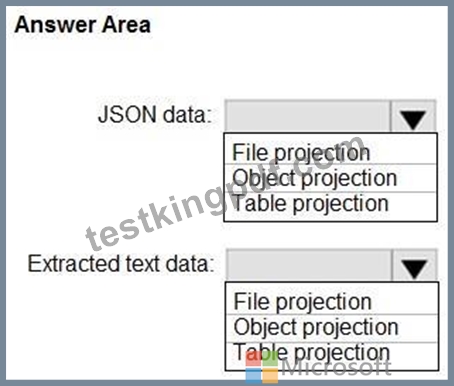
Answer:
Explanation: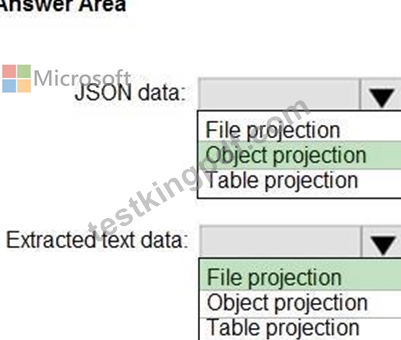
Explanation:
Box 1: Object projection
For the unstructured JSON data, you must use object projection, and for the extracted text data from the scanned PDF documents, you must use file projection.
Object Projection: Projects your data as a full JSON representation. It is ideal for maintaining the original structure alongside any applied AI enrichments within a single JSON document inside Azure Blob Storage.
Box 2: File projection
File Projection: Captures the binary or image extraction layer required during Optical Character Recognition (OCR) processing. It isolates and outputs raw text and graphic details directly from unstructured physical binary files into a designated container Reference:
https://learn.microsoft.com/en-us/azure/search/cognitive-search-concept-image-scenarios
NEW QUESTION # 98
You have a custom agent named Agent1.
You need to control access to and monitor activity for Agent1 by using Microsoft Foundry.
What should you do first?
- A. Create a Microsoft Foundry project.
- B. Add Agent1to a Microsoft Foundry project.
- C. Provision an Application Insights resource.
- D. Add Agent1 to the Microsoft Foundry playground.
Answer: A
Explanation:
To monitor and control access to a custom agent in Azure, you must first create a Microsoft Foundry project. Once the project is created, you register your custom agent within it to enable management capabilities such as access control and activity monitoring.
Reference:
https://learn.microsoft.com/en-us/azure/foundry/control-plane/register-custom-agent
NEW QUESTION # 99
You are designing a content management system.
You need to ensure that the reading experience is optimized for users who have reduced comprehension and learning differences, such as dyslexia. The solution must minimize development effort.
Which Azure service should you include in the solution?
- A. Azure AI Immersive Reader
- B. Azure Translator in Foundry Tools
- C. Azure Document Intelligence in Foundry Tools
- D. Azure Language in Foundry Tools
Answer: A
Explanation:
Include Azure AI Immersive Reader in your solution. It is an applied AI service that provides built- in accessibility features like read-aloud (text-to-speech), real-time translation, line focusing, and customizable typography. It requires no machine learning expertise and integrates easily to minimize development effort.
Reference:
https://azure.microsoft.com/en-us/products/ai-services/ai-immersive-reader
NEW QUESTION # 100
You have a Microsoft Foundry project that ingests scanned PDF invoices stored in Azure Blob Storage. Each invoice contains printed fine items and has a table-based layout.
Extracted results are stored as structured JSON and used as grounding data for an agent in a Retrieval Augmented Generation (RAG) solution.
You need to create a single analyzer that meets the following requirements:
- Extracts the invoice number, invoice date, vendor name, and total
amount across varying templates
- Returns confidence scores so that results with confidence below 0.80
can be routed for supervisor review
What should you use?
- A. the Azure Content Understanding in Foundry Tools prebuilt-documentSearch analyzer and search.score from the Azure AI Search results for routing
- B. a custom Azure Content Understanding in Foundry Tools analyzer that defines the required fields as the extracted fields and the returned confidence scores for routing
- C. the Azure Content Understanding in Foundry Tools prebuilt-layout analyzer
- D. a Foundry agent that has groundedness guardrails enabled to extract invoice fields and confidence scores
Answer: B
Explanation:
The best option in this scenario is a custom Azure Content Understanding in Foundry Tools analyzer that defines the required fields as the extracted fields and the returned confidence scores for routing.
Custom Field Targeting with Confidence Scores: Azure Content Understanding allows you to build a document analyzer with a user-defined schema. By defining your required fields (InvoiceNumber, InvoiceDate, VendorName, and TotalAmount), the service will handle extraction across varying layouts and return a dedicated field-level confidence score. You can natively evaluate these confidence metrics to implement your supervisor routing workflow.
RAG-Ready Output Structure: The service naturally returns highly structured JSON payloads.
This makes it perfectly optimized to be ingested directly as grounding data for a Retrieval- Augmented Generation (RAG) agent.
Incorrect:
[Not C]
The prebuilt-layout analyzer extracts raw structural elements such as blocks of text, hierarchy, selection marks, and complete tables. It does not automatically classify or cleanly isolate specific target entities (like vendor name or total amount) into dedicated schema properties, leaving you with heavy post-processing work to isolate the text.
[Not D]
The prebuilt-documentSearch analyzer is optimized for broad, layout-aware text extraction for indexing. Relying on Azure AI Search's search.score for supervisor routing is conceptually flawed; search.score represents a relevance score for a search query ranking rather than an accuracy metric for data extraction confidence.
Reference:
https://learn.microsoft.com/en-us/azure/ai-services/content-understanding/document/analyzer-improvement
NEW QUESTION # 101
You have a Microsoft Foundry project.
You plan to build a customer support solution that contains an agent. The solution must meet the following requirements:
* Provide accurate, context-aware responses grounded in internal product documentation stored in Azure AI Search.
* Require deep, multi-step reasoning across long contexts.
* Generate detailed natural language responses.
Which type of model should you use to power the agent?
- A. a key phrase extraction model
- B. a large language model (LLM)
- C. a small language model (SLM)
- D. a multimodal model
Answer: B
Explanation:
The correct model type is a large language model (LLM) . The scenario requires an agent that can reason over retrieved documentation, synthesize context-aware answers, and generate detailed natural language responses. Microsoft Foundry RAG guidance defines Retrieval Augmented Generation as a pattern that combines search with large language models so responses are grounded in organizational data, which directly matches the use of Azure AI Search for internal product documentation.
An LLM is also the correct fit for deep, multi-step reasoning across long contexts. Azure AI Search agentic retrieval guidance states that complex chat and agent scenarios use an LLM to break a user query into smaller focused subqueries for better coverage over indexed content. Microsoft also describes Azure AI Search as a way to ground agents and chatbots in proprietary enterprise data for accurate, context-aware responses.
A multimodal model is unnecessary because the requirements are text-focused, not image, audio, or video based. A key phrase extraction model performs narrow text analytics and cannot generate detailed answers.
An SLM may reduce cost and latency, but the stated need for deep reasoning and long-context synthesis favors an LLM. Reference topics: Microsoft Foundry RAG, Azure AI Search grounding, agentic retrieval, and model selection for generative AI agents.
NEW QUESTION # 102
Note: This section contains one or more sets of questions with the same scenario and problem. Each question presents a unique solution to the problem. You must determine whether the solution meets the stated goals. More than one solution in the set might solve the problem. It is also possible that none of the solutions in the set solve the problem.
After you answer a question in this section, you will NOT be able to return. As a result, these questions do not appear on the Review Screen.
You have a multimodal Al generative model that accepts image uploads and uses extracted image text to generate responses.
You discover that users can upload unsafe images and embed hidden instructions into images to manipulate the model.
You need to implement controls to mitigate the risk.
Solution: You configure protected material detection.
Does this meet the goal?
- A. Yes
- B. No
Answer: B
Explanation:
The solution does not meet the goal. Protected material detection is intended to identify large language model output that matches known protected text or code, such as copyrighted text, selected web content, song lyrics, articles, recipes, or code. Microsoft describes protected material detection as a control for preventing AI- generated content from reproducing known protected material, not as a control for image safety or prompt injection.
The stated risk has two parts: users can upload unsafe images, and users can embed hidden instructions in images to manipulate the model. Unsafe image uploads require image moderation, because Azure AI Content Safety provides image APIs that detect harmful content across modalities and can support blocking decisions by harm category and severity. Hidden instructions extracted from images are indirect prompt injection or document attacks; Microsoft Prompt Shields are the capability designed to detect user prompt attacks and document attacks, including harmful instructions embedded in third-party content.
Therefore, protected material detection alone does not mitigate either primary risk. Reference topics: Azure AI Content Safety, image moderation, Prompt Shields, document attacks, indirect prompt injection, and protected material detection.
Topic 1, Case Study Contoso, Ltd
Overview
Contoso, Ltd is a multinational retail company that builds, deploys, and manages generative Al and agent- based solutions by using Microsoft Foundry.
Identity Environment:
Contoso uses Microsoft Entra ID for identity management, authentication, and authorization capabilities that enable agents to access organizational resources and services.
Contoso recently formed a new Al engineering team named Agent1Dev Team to optimize and maintain existing Al solutions.
The team collaborates with solution architects, DevOps engineers, and security engineers to design, implement, monitor, and secure Al applications.
Contoso also has a team named Agent1Test Team that is responsible for validating Al solutions before the solution deployments.
Generative Environment:
Contoso has a Microsoft Foundry deployment that contains two projects named Project1 and Project2.
Project1
Project1 contains a customer support agent named Agent1 that assists customers with product inquiries and troubleshooting requests.
Agent1 has the following configurations:
* Agent1 uses a base model deployment.
* A safety evaluation pipeline is NOT enabled.
* Tool invocation approval workflows are NOT enabled.
* Conversation memory constraints are NOT configured.
Agent1 interacts with customers by using digital support channels and answers general questions about Contoso products.
Project1 is deployed to an Azure region located in the European Union (EU).
Agent1Dev Team will use Project1 to optimize and maintain Agent1.
Project2
Project2 contains a deployed video generation model. The marketing department at Contoso has access to Project2 and plans to use the model to develop a video creation solution.
Development of the solution is incomplete.
Data Environment:
Contoso stores product-related information in Azure resources that support Al applications.
The Azure environment contains an Azure Blob Storage account named storage1 that stores product detail sheets for all the Contoso products.
The product sheets include specifications, feature descriptions, and product support information that Agent1 can use to answer customer questions. The product sheets are stored in the PDF format.
Problem Statement:
Contoso identifies the following issues:
* Agent1 has only general knowledge of the Contoso products.
* A recent chat interaction with Agent1 was analyzed for sentiment. The results of the analysis have NOT been processed yet.
* Agent1 does NOT use the detailed product information in the product sheets stored in storage1 when responding to customer questions.
* The finance department at Contoso reports that vendor invoices must be reviewed manually to ensure that the invoices match the terms defined in the vendor contracts. The invoices contain tables, logos, and varied layouts that make the documents difficult to process consistently.
Requirement:
Planned Changes:
Contoso plans to implement the following changes:
* Implement a solution for Project1 that analyzes the vendor invoices by evaluating both the visual layout and the textual content of the invoices, so that the invoice details can be verified against the vendor contract terms.
* Update the base model deployment used by Agent1 and standardize the model version to ensure continuity and consistent responses.
* Enable Agent1 to retrieve and use the detailed product information from the product sheets stored in storage1.
* Implement an indexing solution for the product sheets that Agent1 can use to answer customer questions.
* Complete the development of the video creation solution.
Technical Requirements:
Contoso identifies the following technical requirements:
* The model deployment used by Agent1 must support scalable, high-throughput generative Al workloads and dynamically scale to handle variable customer support traffic, without requiring reserved throughput capacity.
* The product sheets must be processed by using an indexing pipeline that enables semantic and vector search, so that Agent1 can retrieve the relevant product information.
* Responses generated by using the product sheet information must be relevant, complete, and accurate.
* Agent1 must be able to use the product sheets to answer natural language questions about product details.
* The model version used by Agent1 must remain consistent to ensure stable responses.
* The data processed by the model must remain within the EU.
Safety and Compliance Requirements:
Contoso identifies the following security and compliance requirements:
* API keys must NOT be used to access Foundry-deployed models.
* Access to the Azure resources must follow the principle of least privilege.
* The developers at Contoso must authenticate to Microsoft Foundry resources by using Microsoft Entra authentication.
* Access to Project1 must be assigned to the members of Agent1Dev Team by using a security group named SC_Agent1_Dev.
* Access to Project1 must be assigned to the members of Agent1Test Team by using a security group named SC_Agent1_Test.
* Agent1 must never reveal customer information, even if a document that contains customer data is added erroneously to the product sheet repository in storage1.
* The product sheets might contain images that include embedded text. Agent1 must be protected from malicious instructions potentially hidden within the images.
Business Information:
Contoso identifies the following business requirements:
* Users that interact with Agent1 must have a personalized experience in future interactions, including the ability for Agent1 to retain conversation context and recall relevant information from previous interactions.
* Agent1 must answer questions only about the products sold by Contoso.
NEW QUESTION # 103
You have a Microsoft Foundry project that ingests scanned PDF invoices stored in Azure Blob Storage. Each invoice contains printed line items and has a table-based layout.
Extracted results are stored as structured JSON and used as grounding data for an agent in a Retrieval Augmented Generation (RAG) solution.
You need to create a single analyzer that meets the following requirements:
* Extracts the invoice number, invoice date, vendor name, and total amount across varying templates
* Returns confidence scores so that results with confidence below 0.80 can be routed for supervisor review What should you use?
- A. the Azure Content Understanding in Foundry Tools prebuilt-documentSearch analyzer and search.score from the Azure AI Search results for routing
- B. a custom Azure Content Understanding in Foundry Tools analyzer that defines the required fields as the extracted fields and the returned confidence scores for routing
- C. the Azure Content Understanding in Foundry Tools prebuilt-layout analyzer
- D. a Foundry agent that has groundedness guardrails enabled to extract invoice fields and confidence scores
Answer: B
Explanation:
The correct answer is C because the requirement is structured field extraction from invoices across varying templates, not only OCR or layout preservation. Azure Content Understanding analyzers are reusable configurations that combine content extraction, AI-powered analysis, and structured data output, and Microsoft states that custom analyzers can be created for specific extraction needs. In this case, the analyzer schema should define fields such as invoice number, invoice date, vendor name, and total amount so the output can be returned as structured JSON for downstream RAG grounding.
The confidence-routing requirement also points to Content Understanding field confidence scores. Microsoft documentation states that every field can include a confidence score from 0 to 1, and that confidence scores can be used to automate high-confidence results while routing low-confidence results for human review. A threshold such as 0.80 is therefore an application routing rule based on the returned field confidence. The prebuilt-layout analyzer preserves layout but does not define invoice-specific business fields. Groundedness guardrails evaluate generated answers, not invoice field extraction. Azure AI Search search.score measures retrieval relevance, not extraction confidence. Reference topics: Content Understanding custom analyzers, document field extraction, structured JSON output, confidence scoring, and RAG grounding.
NEW QUESTION # 104
Case Study 1 - Contoso, Ltd
Overview
Company Information
Contoso, Ltd is a multinational retail company that builds, deploys, and manages generative AI and agent-based solutions by using Microsoft Foundry.
Existing Environment
Identity Environment
Contoso uses Microsoft Entra ID for identity management, authentication, and authorization capabilities that enable agents to access organizational resources and services.
Contoso recently formed a new AI engineering team named Agent1Dev Team to optimize and maintain existing AI solutions.
The team collaborates with solution architects, DevOps engineers, and security engineers to design, implement. monitor, and secure AI applications.
Contoso also has a team named Agent1Test Team that is responsible for validating AI solutions before the solution deployments.
Generative Environment
Contoso has a Microsoft Foundry deployment that contains two projects named Project1 and Project2.
Project1
Project1 contains a customer support agent named Agent1 that assists customers with product inquiries and troubleshooting requests.
Agent1 has the following configurations:
- Agent1 uses a base model deployment.
- A safety evaluation pipeline is NOT enabled.
- Tool invocation approval workflows are NOT enabled.
- Conversation memory constraints are NOT configured.
Agent1 interacts with customers by using digital support channels and answers general questions about Contoso products.
Project1 is deployed to an Azure region located in the European Union (EU).
Agent1Dev Team will use Project1 to optimize and maintain Agent1.
Project2
Project2 contains a deployed video generation model. The marketing department at Contoso has access to Project2 and plans to use the model to develop a video creation solution.
Development of the solution is incomplete.
Data Environment
Contoso stores product-related information in Azure resources that support AI applications.
The Azure environment contains an Azure Blob Storage account named storage1 that stores product detail sheets for all the Contoso products.
The product sheets include specifications, feature descriptions, and product support information that Agent1 can use to answer customer questions. The product sheets are stored in the PDF format.
Problem Statements
Contoso identifies the following issues:
- Agent1 has only general knowledge of the Contoso products.
- A recent chat interaction with Agent1 was analyzed for sentiment. The results of the analysis have NOT been processed yet.
- Agent1 does NOT use the detailed product information in the product sheets stored in storage1 when responding to customer questions.
- The finance department at Contoso reports that vendor invoices must be reviewed manually to ensure that the invoices match the terms defined in the vendor contracts. The invoices contain tables, logos, and varied layouts that make the documents difficult to process consistently.
Requirements
Planned Changes
Contoso plans to implement the following changes:
- Implement a solution for Project1 that analyzes the vendor invoices by evaluating both the visual layout and the textual content of the invoices, so that the invoice details can be verified against the vendor contract terms.
- Update the base model deployment used by Agent1 and standardize the model version to ensure continuity and consistent responses.
- Enable Agent1 to retrieve and use the detailed product information from the product sheets stored in storage1.
- Implement an indexing solution for the product sheets that Agent1 can use to answer customer questions.
- Complete the development of the video creation solution.
Technical Requirements
Contoso identifies the following technical requirements:
- The model deployment used by Agent1 must support scalable, high-throughput generative AI workloads and dynamically scale to handle variable customer support traffic, without requiring reserved throughput capacity.
- The product sheets must be processed by using an indexing pipeline that enables semantic and vector search, so that Agent1 can retrieve the relevant product information.
- Responses generated by using the product sheet information must be relevant, complete, and accurate.
- Agent1 must be able to use the product sheets to answer natural language questions about product details.
- The model version used by Agent1 must remain consistent to ensure stable responses.
- The data processed by the model must remain within the EU.
Security and Compliance Requirements
Contoso identifies the following security and compliance requirements:
- API keys must NOT be used to access Foundry-deployed models.
- Access to the Azure resources must follow the principle of least privilege.
- The developers at Contoso must authenticate to Microsoft Foundry resources by using Microsoft Entra authentication.
- Access to Project1 must be assigned to the members of Agent1Dev Team by using a security group named SC_Agent1_Dev.
- Access to Project1 must be assigned to the members of Agent1Test Team by using a security group named SC_Agent1_Test.
- Agent1 must never reveal customer information, even if a document that contains customer data is added erroneously to the product sheet repository in storage1.
- The product sheets might contain images that include embedded text. Agent1 must be protected from malicious instructions potentially hidden within the images.
Business Requirements
Contoso identifies the following business requirements:
- Users that interact with Agent1 must have a personalized experience in future interactions, including the ability for Agent1 to retain conversation context and recall relevant information from previous interactions.
- Agent1 must answer questions only about the products sold by Contoso.
You need to configure personalized user interactions for Agent1. The solution must meet the business requirements.
What should you include in the solution?
- A. memory
- B. tools
- C. knowledge
- D. guardrails
Answer: A
Explanation:
Scenario, Business Requirements:
*-> Users that interact with Agent1 must have a personalized experience in future interactions, including the ability for Agent1 to retain conversation context and recall relevant information from previous interactions.
Agent1 must answer questions only about the products sold by Contoso.
To configure personalized user interactions that retain context and recall previous information, you should use the Memory in Foundry Agent Service.
Managed Long-Term Memory: This allows the agent to extract meaningful information from user conversations and store it as durable knowledge (e.g., user preferences or historical details) to be recalled across future interactions.
Scoped Memory Stores: By using the scope parameter when creating memory stores, you can segment memories to ensure a secure, personalized experience for distinct users.
Automatic Injection: The agent will automatically inject these learned facts and user profile details into the prompt before new interactions, eliminating the need to rehydrate context manually.
References:
https://learn.microsoft.com/en-us/azure/foundry/agents/concepts/what-is-memory
NEW QUESTION # 105
You have a Microsoft Foundry project that contains a support-ticket triage agent built by using the Foundry Agent Service.
The agent uses tool to classify the ticket type and sot the ticket priority.
Sometimes, the same support case continues across multiple sessions over several days.
You need to persist state by using a durable ID to ensure that the agent can automatically reuse the full interaction history. The solution must preserve previous user messages, tool calls and tool outputs across turns and sessions.
Which runtime component should you use?
- A. response
- B. output item
- C. agent
- D. conversation
Answer: D
Explanation:
To achieve state persistence and ensure that the agent automatically reuses the full multi-session interaction history (including previous user messages, tool calls, and tool outputs), you must include a conversation component.
References:
https://learn.microsoft.com/en-us/azure/foundry/agents/concepts/runtime-components
NEW QUESTION # 106
You have a Microsoft Foundry project that contains an agent.
The knowledge source for the agent is a set of scanned PDF troubleshooting guides stored in Azure Blob Storage. The guide pages contain two-column layouts and tables.
You use Azure Content Understanding in Foundry Tools to process the PDFs.
You plan to ingest the processed content into an index for Retrieval Augmented Generation (RAG) and store extracted fields for downstream automation.
Stakeholders must be able to verify where each extracted field value came from in the original PDF and route low-reliability extractions for manual review.
You need to ensure that the Content Understanding document analyzer output includes a per-field confidence score and source grounding locations within the source document.
What should you do?
- A. Provide labeled samples.
- B. Configure the analyzer to use generative extraction for all fields.
- C. Enable estimateFieldSourceAndConfidence.
- D. Set enableSegment to true.
Answer: C
Explanation:
The correct answer is A. Enable estimateFieldSourceAndConfidence . Azure Content Understanding document analyzers support an opt-in confidence and grounding capability for field extraction. Microsoft documentation states that to opt in for confidence and grounding, you set estimateFieldSourceAndConfidence
= true in the analyzer configuration, or configure estimateSourceAndConfidence = true for specific fields.
This enables each extracted field to include a confidence score and references back to the original document source location.
This directly satisfies both stakeholder requirements: source grounding allows users to verify where the extracted value came from in the scanned PDF, and the confidence score supports downstream automation rules, such as sending low-confidence fields to manual review. Microsoft's analyzer improvement guidance describes confidence scoring as a value between 0 and 1 and grounding as references or citations for extracted outputs to the original document content.
Generative extraction does not guarantee per-field confidence and source grounding. enableSegment is used for document segmentation, not confidence scoring. Labeled samples can improve extraction quality, but they do not by themselves enable confidence and grounding output. Reference topics: Content Understanding document analyzers, field extraction, confidence scoring, grounding, and RAG ingestion.
NEW QUESTION # 107
You are building a web app named App1 that generates responses by using a model deployed to a Microsoft Foundry project named Project1.
Before sending the prompts to the model, App1 must retrieve documents by using Azure AI Search.
You need to integrate Project1 and App1. The solution must meet the following requirements:
- Multiple client applications must use the same search configuration.
- A security policy must prevent key-based authentication.
- Administrative effort must be minimized.
What should you do?
- A. Configure an Azure AI Search connection in Project1 and reference the connection in each application.
- B. Call Azure AI Search directly from each application by using Microsoft Entra authentication.
- C. Create a custom HTTP connection in Foundry and manually configure Azure AI Search endpoints per application.
- D. Enable a managed identity for each application and call Azure AI Search directly.
Answer: A
Explanation:
To meet your security and architecture requirements, you must add the Azure AI Search instance as a Connection within your Azure AI Foundry project and configure Managed Identities for role- based access control (RBAC).
To securely unify your search configuration without API keys, add the Azure AI Search instance as a shared Connection in your Azure AI Foundry project, disable key authentication on the search service, and authorize your applications using Azure RBAC and Managed Identities.
Note:
*-> 1. Create a Project Connection
Connect Azure AI Search directly inside the Azure AI Foundry hub or project.
*-> Share the same search service configuration across all connected client applications automatically.
Centralize your search endpoint details to reduce administrative overhead.
2. Disable Key Authentication
3. Enable Managed Identities
4. Update the Web App Code
Reference:
https://learn.microsoft.com/en-us/azure/foundry-classic/tutorials/copilot-sdk-create-resources
NEW QUESTION # 108
You have a Microsoft Foundry project that contains an agent named Agent1.
Agent runs successful, but Foundry Control Plane does NOT display values for error rates, runs, and token usage, and the Traces tab is empty.
You need to ensure that Found Control Plane displays the appropriate values for Agent1.
What should you do?
- A. Assign to a Log Analytics workspace to Agent1.
- B. Update Agent1 to a new version.
- C. Enable Application Insights for Agent1.
- D. Restart Agent from Foundry Control Plan
Answer: C
Explanation:
To resolve this issue, you must connect and configure an Azure Application Insights resource for your Microsoft Foundry project.
The Foundry Control Plane, its Agent Monitoring Dashboard, and the Traces tab rely directly on telemetry data stored within the connected Application Insights instance. If this resource is missing, unlinked, or improperly configured, the dashboard cannot display runs, error rates, token usage, or transaction spans.
Reference:
https://techcommunity.microsoft.com/blog/azure-ai-foundry-blog/monitoring--observability-in-microsoft-foundry/4517250
NEW QUESTION # 109
Your company is piloting a customer support agent in a Microsoft Foundry project name Project1. Project1 is connected to an existing Application Insights resource, and the company ' s support team reviews runs in the Traces tab.
The Foundry Agent Service is configured to perform the following actions:
* Retrieve the Application Insights connection string by calling
project_client.telemetry.get_application_insights_connection_string().
* Call configure_azure_monitor(connection_string=...) to enable telemetry.
A separate LangChain service configured to use OpenTelemetry and has the following configurations:
* Uses AzureAIOpenTelemetryTracer(connection_string=..., enable_content_recording=False)
* Passes the tracer by using config={ " callbacks " :[azure_tracer]}
Company policy has the following requirements:
* Telemetry from LangChain and OpenTelemetry must be distinguishable within the same Application Insights resource.
* Secrets and credentials must NOT be stored in prompts, tool arguments, or span attributes.
For each of the following statements, select Yes if the statement is true. Otherwise, select No.
NOTE: Each correct selection is worth one point.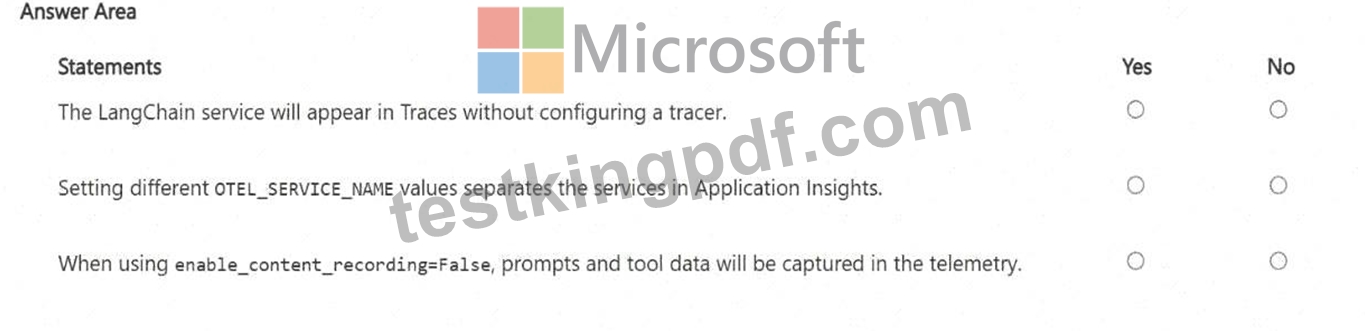
Answer:
Explanation: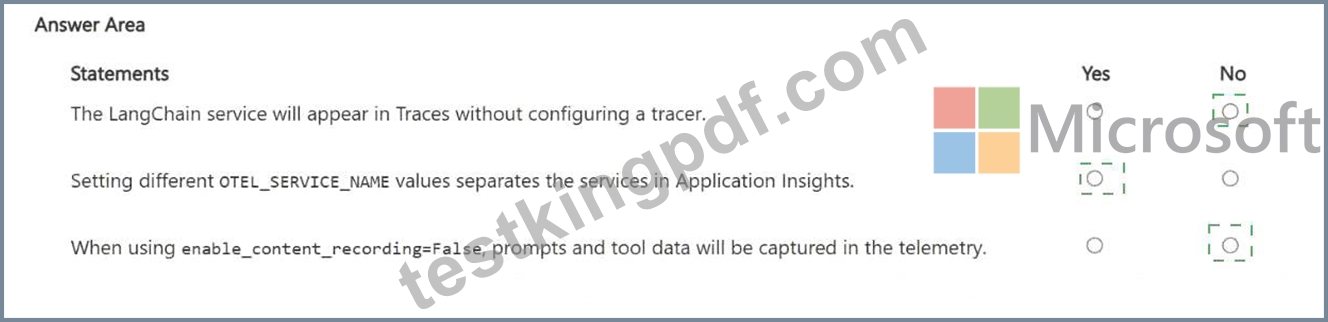
Explanation:
The LangChain service will appear in Traces without configuring a tracer: No Setting different OTEL_SERVICE_NAME values separates the services in Application Insights: Yes When using enable_content_recording=False, prompts and tool data will be captured in the telemetry: No The first statement is No because a separate LangChain or LangGraph application must emit telemetry through the configured tracing integration. Microsoft's LangChain tracing guidance states that you configure AzureAIOpenTelemetryTracer, attach it to the runnable or agent through callbacks, and then inspect the emitted traces in Azure Monitor. The troubleshooting guidance also states that missing LangChain or LangGraph spans are caused by tracing callbacks not being attached to the run.
The second statement is Yes . In OpenTelemetry, OTEL_SERVICE_NAME maps to the service.name resource attribute. Azure Monitor Application Insights uses cloud role names to represent separate services, and Microsoft states that when multiple services emit to the same Application Insights resource, cloud role names must be set so services are represented properly.
The third statement is No . enable_content_recording=False is specifically used to redact message content and tool call arguments from traces. Microsoft also advises disabling content recording in production and not storing secrets, credentials, or tokens in prompts or tool arguments. Reference topics: Microsoft Foundry tracing, LangChain tracing, OpenTelemetry service naming, Application Insights, and secure telemetry configuration.
NEW QUESTION # 110
You have a Microsoft Foundry project that contains a customer support agent built by using the Foundry Agent Service.
The agent uploads user-provided screenshots to Azure Storage through a ticketing tool and receives a blob URL for additional reasoning.
You need to use image moderation during agent runs and prevent harmful content from being returned during runs. Azure Al Content Safety must access the images by using the blob URL. The solution must follow the principle of least privilege.
What should you configure for Content Safety? To answer, select the appropriate options in the answer area.
NOTE: Each correct selection is worth one point.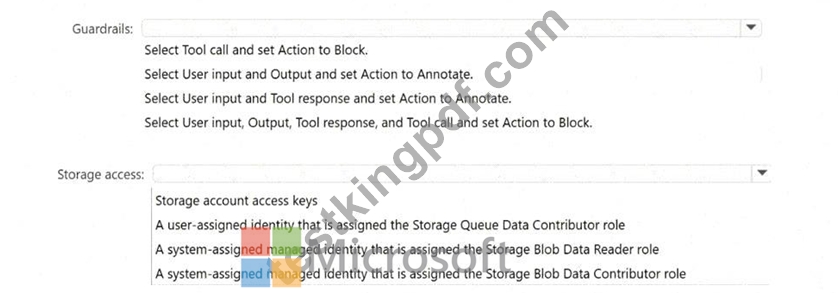
Answer:
Explanation: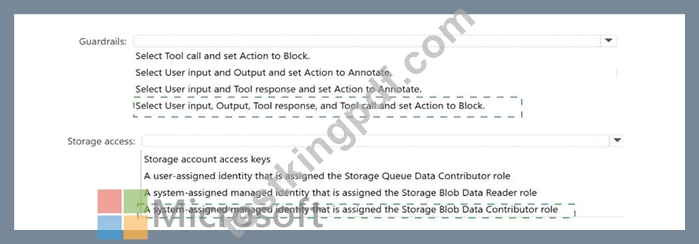
Explanation:
Guardrails: Select User input, Output, Tool response, and Tool call and set Action to Block.
Storage access: A system-assigned managed identity that is assigned the Storage Blob Data Contributor role The guardrail must be applied to User input, Output, Tool response, and Tool call with the action set to Block . Microsoft Foundry guardrails support four intervention points: user input, tool call, tool response, and output. This scenario includes user-provided screenshots, a ticketing tool that uploads images and returns blob URLs, and final agent responses. Applying blocking controls at all four points ensures harmful image-related content is inspected throughout the agent run and prevented from continuing or being returned to the user.
Microsoft's guardrails guidance also states that tool call and tool response controls are specifically required when harmful content can pass through agent tools.
For storage, configure the Azure AI Content Safety resource with a system-assigned managed identity and grant it Storage Blob Data Contributor on the storage account or container. The Content Safety image moderation quickstart states that images can be supplied by blob storage URL and that the Content Safety resource must be given storage access by enabling its system-assigned managed identity and assigning Storage Blob Data Contributor or Owner; Contributor is the least-privileged valid option shown. Reference topics: Foundry guardrails, agent intervention points, image moderation, managed identity, and Azure Storage RBAC.
NEW QUESTION # 111
A multimodal agent processes user-uploaded images. An attacker embeds hidden text instructions inside an image, hoping the agent will read and act on them. Which Azure AI Content Safety capability is designed to detect this kind of attack?
- A. Prompt Shields, which detects document and indirect prompt injection
- B. Disabling the agent's file search tool
- C. A content filter set to High severity for the Violence category
- D. Raising the image resolution threshold on the analyser
Answer: A
Explanation:
Prompt Shields detects prompt injection attacks, including indirect injection where malicious instructions are embedded in content the model processes, such as text hidden inside an image.
NEW QUESTION # 112
You have a Microsoft Foundry project that contains a customer support agent built on a deployed chat model.
The agent responses are validated by using an automated testing system that compares generated answers to stored expected outputs. Identical prompts must return consistent response to prevent automated test failures.
You need to reduce response variability, without modifying the prompt or reducing factual accuracy.
What should you do for the model?
- A. Increase the temperature parameter.
- B. Increase the max_tokens parameter.
- C. Remove stop sequences from the requests.
- D. Decrease the temperature parameter.
Answer: D
Explanation:
To reduce response variability and ensure identical prompts return consistent answers, you should decrease the temperature parameter.
Temperature controls the randomness of the model's output. Setting the temperature closer to 0 makes the model deterministic. It forces the model to choose the highest-probability words every time, ensuring that identical prompts consistently yield identical or near-identical responses to pass your automated testing.
Reference:
https://learn.microsoft.com/en-us/azure/foundry/agents/concepts/runtime-components
NEW QUESTION # 113
Hotspot Question
You have a Microsoft Foundry project that contains an agent.
The agent uses tools to retrieve internal content and call external APIs. The agent is configured to let the model decide when to call the tools.
You need to publish the agent for a compliance workflow. The solution must meet the following requirements:
- Each workflow run must include a retrieval step before generating a
response.
- Tool calls must authenticate by using the published agent's own
identity.
- Tool access must use an identity isolated from other project
resources.
- Tool access must use support audit tracing.
What should you do? To answer, select the appropriate options in the answer area.
NOTE: Each correct selection is worth one point.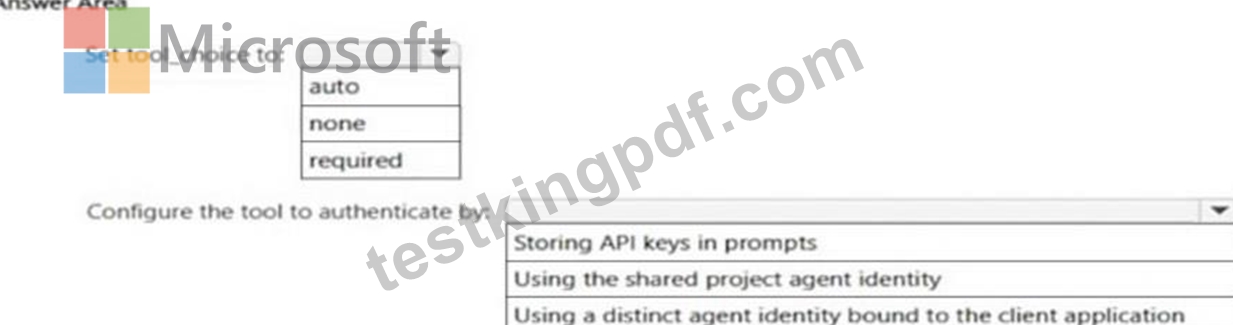
Answer:
Explanation: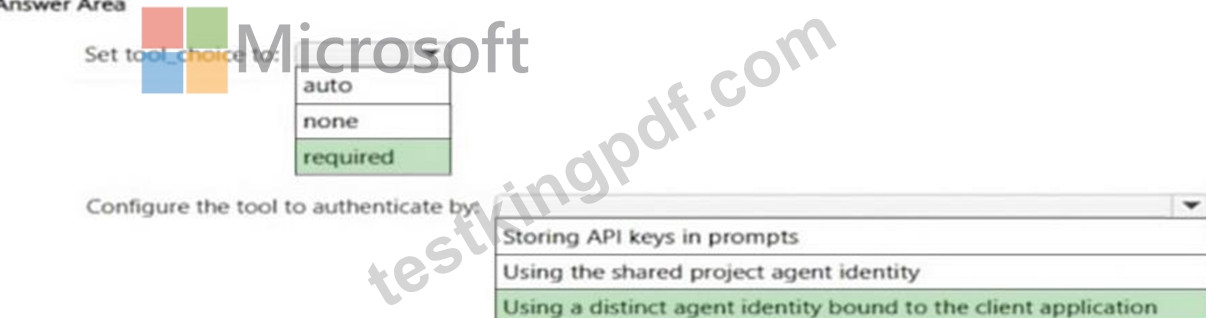
NEW QUESTION # 114
......
Latest AI-103 Exam Dumps Microsoft Exam from Training: https://examtorrent.testkingpdf.com/AI-103-testking-pdf-torrent.html
